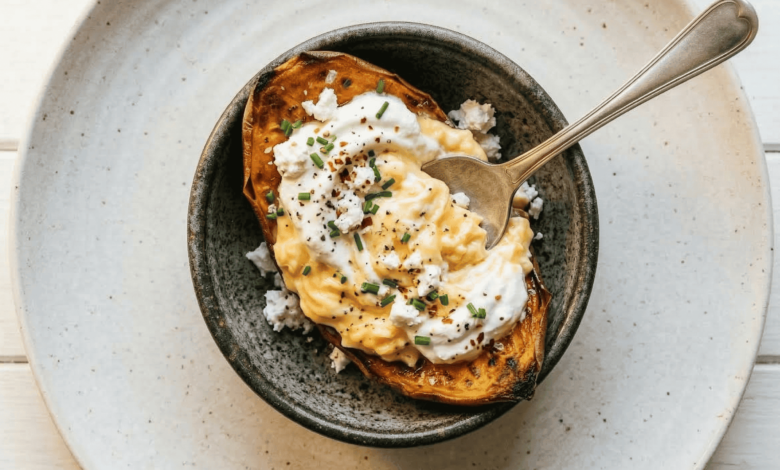
If you have been searching for a wheat-free breakfast that does not feel like a trade-down from toast, this is the recipe that ends that search. Whipped Feta Scrambled Eggs on Sweet Potato Toast is built entirely without wheat, uses no bread substitutes, no specialist flours, and no compromises. Thick slabs of sweet potato roasted until caramelised and tender become the base. A cloud of whipped feta, tangy, creamy, impossibly light, goes on next. Then the softest, slowest-cooked scrambled eggs you have ever made settle on top. The whole plate takes 25 minutes, delivers 34 grams of protein, and looks like something you would pay fifteen pounds for in a brunch café. No wheat was ever needed here. This is simply what breakfast should look like.
Wheat-FreeGluten-FreeVegetarianHigh Protein — 34gNo BreadReady in 25 Minutes1 Serving
What Makes This the Wheat-Free Breakfast Worth Making on a Weekday
Sweet potato toast has been quietly the most practical wheat-free bread replacement for years, but most people treat it as exactly that: a replacement, a workaround, something you eat because you cannot have the real thing. This recipe reframes it completely. Roasted sweet potato slabs are not an imitation of toast. They are something better, caramelised, dense, naturally sweet against savoury toppings in a way that no slice of bread has ever managed. They hold weight without collapsing, they crisp beautifully at the edges under a hot grill, and they bring a nutritional profile, beta-carotene, fibre, complex carbohydrates, that ordinary toast cannot come close to matching.
What transforms this recipe from good to genuinely extraordinary is the whipped feta. Block feta blended with cream cheese and olive oil until completely smooth becomes something that bears almost no resemblance to its starting point. It is light, tangy, spreadably creamy, and so good eaten by the spoonful that most people make extra to keep in the fridge for the rest of the week. It is the component that turns this breakfast into a destination rather than a routine. Slow-cooked scrambled eggs settle on top, and the whole plate is finished with fresh herbs, a thread of honey, and a crack of black pepper. Every ingredient is naturally, inherently wheat-free. Nothing here is a substitute for anything. This is simply one of the best breakfasts in the repertoire.
| 34g Protein | 25 Total Minutes | 100% Wheat-Free | 1 Serving | 0g Wheat |
The Ingredients That Make This Breakfast Work
Sweet Potato: The Wheat-Free Base That Earns Its Place
Sweet potato is not a bread substitute in this recipe. It is the foundation the whole dish is designed around. Sliced lengthways into thick slabs approximately 1cm deep, roasted at high heat until the cut faces are deeply golden and caramelised, and then briefly grilled to crisp the surface further, it becomes something entirely its own: dense and tender through the middle, with edges that hold a satisfying bite, and a natural sweetness that plays against the salty feta and savoury eggs in a way that makes every mouthful more interesting than the last. A medium sweet potato makes two large slabs, the ideal base for a single generous serving. Sweet potato is completely, inherently wheat-free, with no cross-contamination risk and no label to check.
Sweet Potato Prep Tip Choose a sweet potato that is as uniformly cylindrical as possible. This gives you flat, even slabs rather than wedge-shaped pieces that balance awkwardly on the plate. Aim for slabs exactly 1cm thick: thinner than this and they dry out; thicker and the centre stays underdone while the surface colours. Pat the cut faces dry with kitchen paper before roasting. Surface moisture is what prevents proper caramelisation and leaves you with steamed rather than roasted sweet potato. |
Whipped Feta: The Ingredient That Makes This Recipe Unmissable
Whipped feta is the component that elevates this breakfast from nutritious to extraordinary, and it could not be simpler to make. Block feta (not pre-crumbled, which is too dry) blended with cream cheese and a splash of extra-virgin olive oil becomes a cloud-like spread with a tangy, creamy, slightly salty character that is addictive in the most sincere sense of the word. The key is using a full-fat block feta in brine. The brine keeps it moist and gives it the pliability that makes it blend smoothly rather than crumbling. Whipped feta is naturally wheat-free: feta is made from sheep’s milk (sometimes with a percentage of goat’s milk), cream cheese from dairy, and olive oil from olives. Not a trace of wheat anywhere. Make a full batch, three times this recipe, and keep it in the fridge for up to five days. You will find uses for it that go far beyond breakfast.
Label Check Block feta and plain cream cheese are both naturally wheat-free. The risk only arises with flavoured cream cheese varieties. Herb, garlic, or onion blends occasionally contain wheat-derived stabilisers or thickeners. Always use plain, full-fat cream cheese in this recipe. Philadelphia Original is consistently safe. Pre-crumbled feta should also be avoided here. It lacks the moisture needed to blend smoothly and produces a grainy, broken texture rather than the whipped cloud this recipe requires. |
Slow-Cooked Scrambled Eggs: The Technique That Changes Everything
The scrambled eggs in this recipe are not the kind you make in 90 seconds on high heat. They are the kind that take 4 minutes over the lowest heat your hob will produce, stirred almost constantly, pulled off the heat every 20 seconds to prevent them catching, and the result is something that barely resembles supermarket scrambled eggs in any meaningful way. The curds are large, silky, and barely set; the texture is almost custard-like; and the flavour of the egg itself comes through in a way it never does when cooked fast. Three eggs cooked this way, finished with a knob of butter and a pinch of fine salt, contribute approximately 18g of protein and produce a volume of eggs that more than covers two sweet potato slabs generously. The technique takes one extra minute and produces a result worth ten times that time investment.
The Finishing Layer: Honey, Fresh Herbs, and Black Pepper
A thin thread of raw honey drizzled over the finished plate does something that sounds counterintuitive and tastes inevitable: it sharpens the savouriness of the feta, amplifies the caramelised sweetness of the sweet potato, and ties the whole plate together into something cohesive. Fresh herbs, chives, dill, or flat-leaf parsley, any of the three, add a bright, green contrast to the richness of the eggs and feta. Freshly cracked black pepper, added in the final second before the plate goes to the table, is the note that makes everything else land. All four finishers are completely wheat-free with no label check required.
| “The moment you stop thinking of sweet potato as a bread replacement and start thinking of it as the best possible base for scrambled eggs, everything changes. This is not a wheat-free breakfast. It is just breakfast, and it happens to be better than most.” |
Full Recipe Whipped Feta Scrambled Eggs on Sweet Potato ToastRoasted sweet potato slabs topped with blended feta and cream cheese, slow-cooked scrambled eggs, fresh herbs, and a honey drizzle. 34g protein. No wheat. No bread. Ready in 25 minutes. | ||||||||||||||||||||||||||||||||||||||||||||||||||||||||
| ||||||||||||||||||||||||||||||||||||||||||||||||||||||||
Wheat-FreeGluten-FreeVegetarian34g ProteinNo Bread25 Minutes ✓ | ||||||||||||||||||||||||||||||||||||||||||||||||||||||||
Ingredients The Sweet Potato Base
The Whipped Feta
The Scrambled Eggs
To Finish
Equipment
| Instructions
Nutrition Per Serving (approx.)
| |||||||||||||||||||||||||||||||||||||||||||||||||||||||
Meal Prep Guide: Making This Work on Weekday Mornings
This recipe is written as a single fresh serving, and the scrambled eggs genuinely must be made fresh every time, because slow-cooked scrambled eggs do not reheat. However, both the other components prep ahead beautifully and turn this into a 10-minute weekday morning rather than a 25-minute one.
The whipped feta keeps in a sealed jar in the refrigerator for up to five days with no change in flavour or texture. Make a triple batch, 300g feta, 180g cream cheese, 3 tbsp olive oil, 3 tsp lemon juice, blend it all at once, and divide into a jar. Each morning, scoop what you need directly from the fridge while the sweet potato is in the oven. The sweet potato slabs can also be roasted the night before and stored in the refrigerator. Reheat under the grill for 3 to 4 minutes in the morning while the eggs are cooking to restore the caramelised surface and warm the flesh through.
Make-Ahead Tip The whipped feta is the most versatile component in your fridge for the week ahead. Beyond this breakfast, use it on wheat-free crackers with sliced cucumber, as a dip for crudités, spooned alongside roasted vegetables at dinner, or as the base of a salad bowl. Making a full 300g batch on Sunday means you have five days of instant protein from a single 3-minute blend. |
Where the 34g of Protein Comes From
Like every high-protein recipe on WheatlessRecipes, this one builds entirely from whole food ingredients, no powder, no supplement, nothing engineered. Here is exactly how the 34g stacks per single serving:
- 3 large eggs — approximately 18g protein
- Block feta, 100g — approximately 10g protein
- Full-fat cream cheese, 60g — approximately 4g protein
- Sweet potato, 250g — approximately 2g protein
Every gram comes from a whole food that is naturally wheat-free at source. No label checking beyond the cream cheese (plain only), no cross-contamination risk in any primary ingredient, and no compromise on flavour in exchange for the protein count. This is what wheat-free eating built on real food looks like.
Recipe Variations
|
|
|
|
Frequently Asked Questions
Can I make sweet potato toast in a toaster instead of the oven? Yes. A wide-slot toaster works for this if your sweet potato slabs are thin enough (no more than 8mm). Run the toaster on its highest setting twice in succession. The result is slightly less caramelised than oven-roasted but perfectly acceptable for a weekday morning when the oven feels like too much. The oven method produces a noticeably superior result in terms of caramelisation, texture, and flavour. On a weekend, it is always worth it. |
Do I need a food processor for the whipped feta? A food processor or blender gives the smoothest, lightest result. A hand blender also works well. In the absence of either, you can combine the feta and cream cheese with a fork and beat vigorously. The texture will be less cloud-like and slightly more rustic, but still excellent. The key is starting with the feta at room temperature, which makes it significantly more pliable and easier to blend or beat smooth. |
My scrambled eggs are rubbery. What went wrong? Almost always, the heat was too high. Rubbery scrambled eggs are overcooked scrambled eggs. The proteins have tightened fully and expelled their moisture. For this recipe, the heat must be the absolute lowest setting your hob produces. If your hob runs hot even on its lowest setting, use a heat diffuser mat or cook in a bain-marie (a heatproof bowl set over a saucepan of barely simmering water). The other common mistake is leaving the eggs in the pan after removing from heat. Always transfer immediately to the plate, as residual pan heat continues cooking them. |
Can I use sweet potato from the night before? Yes, and this is actively recommended for weekday mornings. Roast the sweet potato slabs the night before, allow them to cool fully, and store in a sealed container in the fridge. In the morning, place them under a hot grill for 3 to 4 minutes, turning once, until heated through and the surface has re-crisped. The texture is marginally different from freshly roasted, slightly denser at the centre, but the caramelised edges return fully under the grill and the overall result is excellent. |
Is feta cheese always wheat-free? Plain block feta is naturally wheat-free. It contains only sheep’s milk (sometimes with goat’s milk), salt, and bacterial cultures. No wheat is used or needed in its production. The risk arises with flavoured feta varieties, herb-coated, marinated in oil with added ingredients, or pre-crumbled with anti-caking agents, which can occasionally contain wheat-derived additives. For this recipe, always use plain block feta packed in brine. Check the label on flavoured or marinated versions before using. |
The Verdict
Whipped Feta Scrambled Eggs on Sweet Potato Toast is not a wheat-free version of eggs on toast. It is something better than eggs on toast, a breakfast with more protein, more flavour complexity, more visual impact, and more reasons to make it on a Tuesday morning than any slice of bread has ever given anyone. The sweet potato base earns its place not by imitating bread but by being entirely itself. The whipped feta is the kind of component that changes how you think about what a wheat-free refrigerator can contain. And the slow-cooked eggs are the reminder that technique, not ingredients, is what separates a forgettable breakfast from one you think about for the rest of the day.
Twenty-five minutes. Thirty-four grams of whole-food protein. Zero wheat. Make it once and the concept of missing toast will simply not occur to you again.
| If you made this breakfast, pin it to your wheat-free breakfast board and share with your followers. Every save helps another home cook discover that wheat-free mornings do not ask you to give up anything worth keeping. |